


Tips: Testing Services from LMS Compliance Could Quietly Rewire Our Daily Lives — A Sustainable Investor’s View of Asia Pacific’s TIC Boom
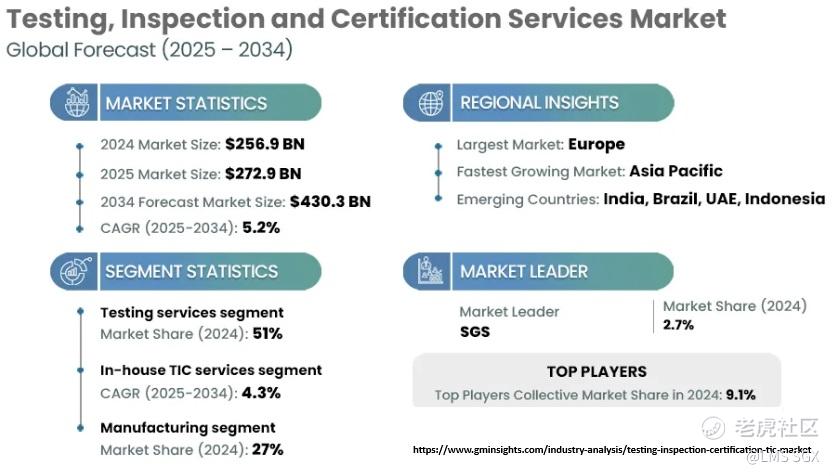
Introduction The Testing, Inspection and Certification (TIC) market is growing fast — projected to climb from roughly $273B in 2025 to $430B by 2034 at a ~5.2% CAGR — and Asia Pacific is the fastest-growing region. For sustainability-minded investors, that growth isn’t just a financial story: it’s the engine that can materially improve lifestyle, safety, and security across everyday life. LMS Compliance (through its MY CO2 group labs) sits at the intersection of rigorous testing capability and regional reach. Here’s why investors who care about durable returns and long-term resilience should pay attention.
Why testing services are a sustainability multiplier
-
Risk reduction that scales: Reliable lab testing prevents product recalls, chemical exposures, and unsafe building systems before they cascade into public-health or environmental crises. That lowers social and regulatory risk for companies — and portfolio downside for investors.
-
Enabling green transitions: Accurate testing of greentech materials, emissions, and product life-cycle parameters lets companies verify sustainability claims (e.g., low-VOC materials, bio-based products, clean manufacturing). This verification is essential for credible ESG labels and green finance.
-
Productivity + health = economic resilience: Routine occupational health testing (a capability LMS offers) reduces worker illness and downtime, increasing output and improving livelihoods — outcomes investors increasingly value under ESG frameworks.
LMS Compliance’s strategic advantages (from an investor lens)
-
Accredited, scalable lab footprint: LMS’s three ISO/IEC 17025-accredited labs (Penang, Shah Alam, Johor Bahru) and >1,100 accredited test types mean broad serviceable demand across food, pharma, medical devices, healthcare, industrial, and greentech sectors.
-
Local presence, regional tailwinds: Asia Pacific’s fast growth, rising regulation, and expanding middle-class consumption create repeated, sticky demand for testing services — from food safety to medical device certification. Local accreditation and relationships lower customer acquisition costs and barriers to competition.
-
Diversified service lines: Chemical, microbiology, nucleic acid, and physical analyses, plus safety and occupational health testing (ISO 45001-compliant) form a diversified recurring-revenue base that is countercyclical in many downturns (safety and compliance don’t pause).
-
High switching costs & trust moat: Accreditation, validated methods, and deep technical competence create trust that’s hard to replicate. Once corporate procurement and regulators accept a lab’s reports, that source becomes preferred.
Concrete ways LMS testing can change daily life
-
Safer food and feed: Faster, reliable contamination detection reduces foodborne illness, protecting families and reducing healthcare costs.
-
Cleaner homes and workplaces: Verification of low-toxicity building materials, paints, and consumer goods lowers chronic exposure to harmful chemicals across communities.
-
More secure healthcare products: Robust testing for medical devices and pharmaceuticals reduces the risk of faulty products entering supply chains — improving patient safety and confidence.
-
Enabling sustainable products: Independent verification for greentech components (e.g., battery materials, bioplastics) helps scale low-carbon solutions with credible performance claims.
Market dynamics that favour investors in TIC players like LMS
-
Regulatory tightening in Asia: Governments will increasingly mandate testing and certification to meet public health and sustainability goals — creating recurring demand.
-
Fragmented supply; consolidation potential: The global top players still hold a modest collective share (~9.1% in 2024). Local accredited labs with regional scale are prime acquisition targets or consolidation leaders, offering exit pathways.
-
Higher margin adjacencies: Value-added services — traceability reporting, digital certificates, data analytics on test results, and sustainability verification — can increase revenue per client and open subscription-like models.
ESG-aligned investment thesis — metrics to watch
-
Capacity and accreditation growth: New accredited test types and lab expansions indicate serviceable market expansion.
-
Revenue mix by vertical (food, pharma, greentech): Growth in greentech and medical device testing signals higher-margin, future-facing demand.
-
Client retention and contract length: High retention means predictable cash flows.
-
Digitalisation and data services adoption: Monetizable analytics on testing data — e.g., predictive quality failure models for manufacturers — add scalable margins.
-
Carbon and waste footprint of lab operations: A credible sustainability policy for lab energy use, waste treatment, and chemical disposal reduces ESG liabilities and aligns the company with investor values.
Risks and mitigations investors should consider
-
Regulatory exposure: Changes in standards or recognition can shift demand. Mitigation: maintain multiple accreditations, active engagement with standards bodies.
-
Competitive consolidation: Larger global labs could enter aggressively. Mitigation: deepen customer relationships, invest in niche high-value tests, and pursue strategic partnerships.
-
Operational hazards: Labs face health, chemical, and biosecurity risks. Mitigation: strict ISO-compliant procedures, staff training, and insurance.
The TIC market’s steady expansion, especially across the Asia Pacific, makes testing providers more than service vendors — they are infrastructure for safety, sustainability, and trust in modern supply chains. LMS Compliance, through its accredited MY CO2 laboratories and broad test catalogue, occupies a strategic position to convert regulatory demand and sustainability transitions into durable cash flows. For investors who prioritise sustainability and long-term resilience, backing companies that enable verified safety and credible green claims is both an ethical choice and a smart allocation: it helps reshape daily life—cleaner food, safer workplaces, trustworthy healthcare — while capturing an attractive slice of a growing market.
免责声明:上述内容仅代表发帖人个人观点,不构成本平台的任何投资建议。
