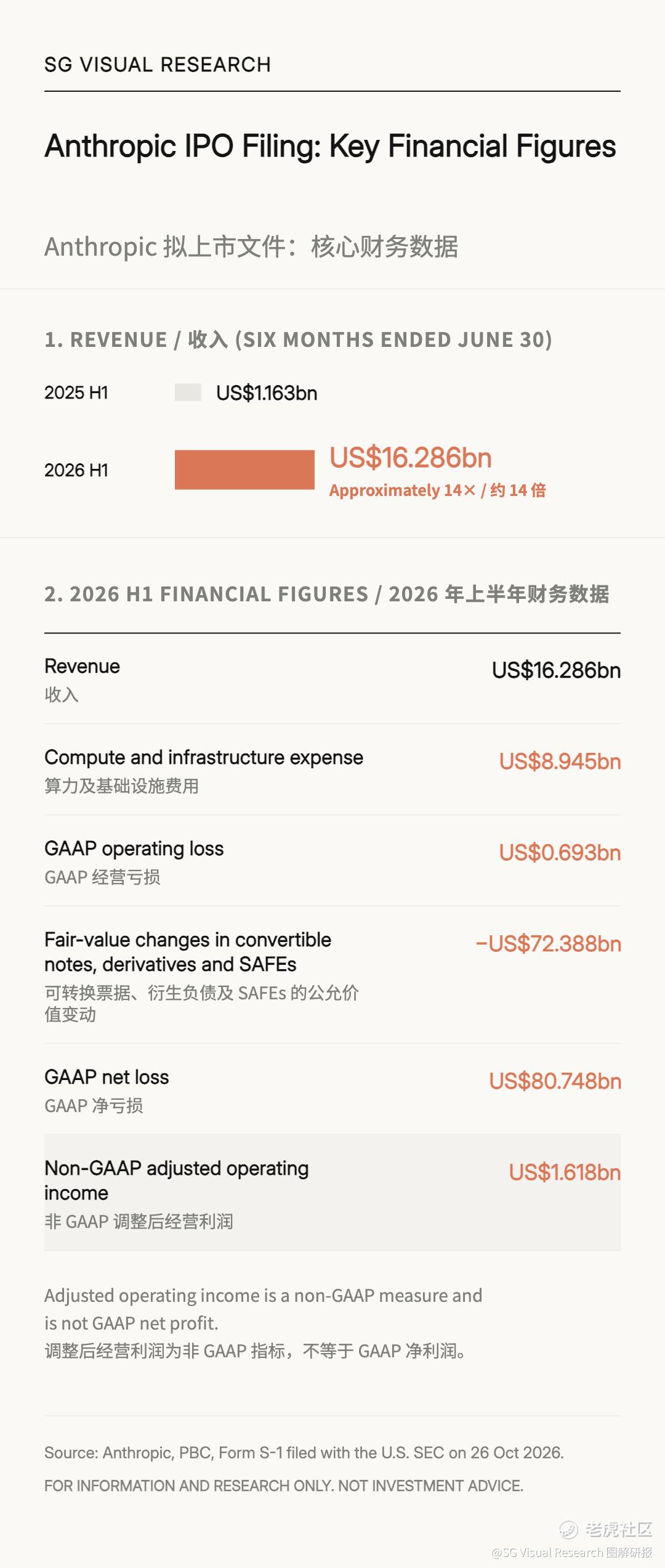
Anthropic reported $16.286 billion in revenue and a $80.748 billion GAAP net loss for the first half of 2026. Put those figures side by side and they make a striking headline. They do not, on their own, tell us how the business is performing.
The first distinction is between an accounting loss and an operating loss. The net loss includes a $72.388 billion change in the fair value of convertible notes, derivative liabilities and SAFEs. That charge is not the same as spending $72 billion in cash. But setting it aside does not mean Anthropic was profitable under GAAP: its operating loss for the period was $693 million.
The filing also reports $1.618 billion in adjusted operating income. That is a company-defined, non-GAAP measure with its own adjustments. It is useful to examine, but it should not be presented as GAAP net profit. All three figures matter; they answer different questions.
The growth is no less remarkable once those distinctions are made. Revenue rose from $1.163 billion in the first half of 2025 to $16.286 billion a year later. Customers are paying for Claude, and adoption is expanding rapidly. What interests me is the cost of delivering that growth.
Anthropic recorded $8.945 billion in compute and infrastructure expense in the first half of 2026. More customer usage requires more capacity, and capacity often has to be secured before demand is fully realised. Too little can constrain growth. Too much can leave the company paying for resources it cannot yet put to productive use. The filing discusses both risks in concrete terms.
That makes the question ahead more demanding than “Can Anthropic keep growing?” It is whether greater usage can consistently produce enough revenue to justify the compute required to support it. Revenue growth tells us how quickly customers are adopting the product. Over time, capacity utilisation and operating results will tell us more about the durability of the business.
There is another part of the S-1 that deserves just as much attention as the income statement. Anthropic proposes to sell Class A shares to the public, while an entity formed by its seven co-founders will hold a special Class F share carrying 50.1% of the voting power on general stockholder matters. Its Long-Term Benefit Trust will generally have the right to elect a majority of the board. Public investors may supply capital, but the company has been explicit about where much of its decision-making authority will remain.
The $16.286 billion in revenue shows the scale of demand. The $8.945 billion in compute expense shows that serving it is not cheap. The governance provisions show who will make the long-term decisions as Anthropic enters the public market. Together, they offer a more useful way to read this filing than the net-loss headline alone.
Source: Anthropic, PBC, Form S-1 filed with the U.S. SEC on 26 October 2026.
Disclaimer: For information and research purposes only. Not investment advice. The prospectus is preliminary and its contents and offering terms may change.
精彩评论