Return on equity (ROE) is a financial performance metric that is calculated by dividing a company's net income by shareholders' equity.
In simple terms, ROE tells you how efficiently a company uses its net assets to produce profits. Shareholders' equity is calculated as total assets minus total liabilities.
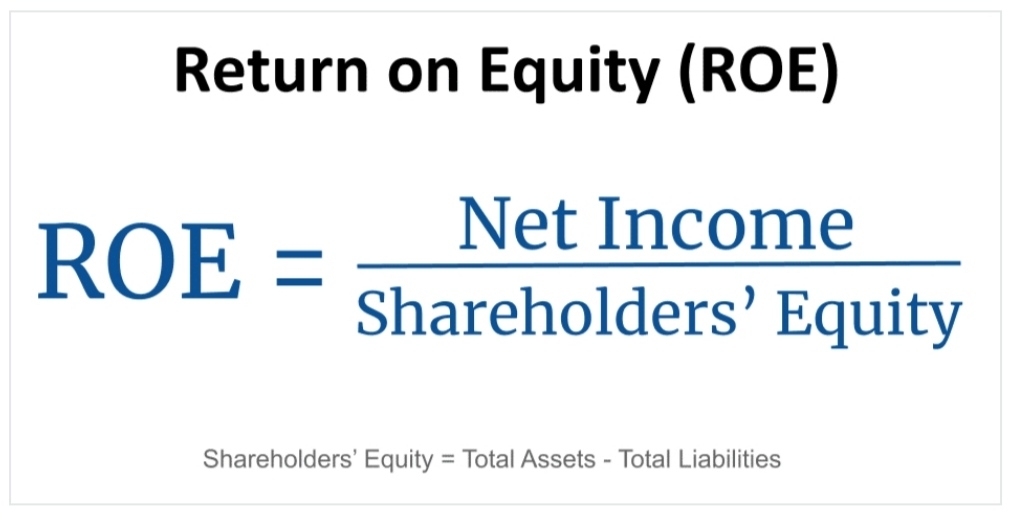
Net income can be found on the company's income statement, but shareholders' equity is listed on the balance sheet. Shareholders' equity is often simply called equity. It is the same as book value and also called net assets or net worth.
A high return on equity means that a company is good at producing profits. It also means that the business has the potential to grow its earnings in the future.
Why return on equity is important
The higher the ROE, the more effective the company is at producing profits relative to its equity.
In this case, equity is money that has been invested in the business by shareholders, plus money that investors have retained in the business.
In other words, equity is money from investors.
The return on equity gives investors an idea of how effectively a company's management is using the money invested in it to produce profits.
For example, an ROE of 0.20 or 20% implies that the company can produce 20 cents of profit per year for each dollar of equity.
In other words, if shareholders invest a dollar in the business, the company will turn it into 20 cents of profit per year.
Or if investors let the company retain a dollar of earnings instead of paying it out as dividends, the company will make 20 cents of profit per year from that dollar.
A high return on equity makes it attractive for investors to not only invest in the business but also retain money in the business instead of paying it out as dividends.
Another benefit of having a high return on equity is growth potential. A high number suggests that a company will be able to grow its earnings over time by reinvesting them back into the business.
Takeaway
Return on equity (ROE) is a great financial ratio to see how efficiently a company's management uses shareholder money to produce profits.
However, it is just one of many financial ratios and has several limitations. It needs to be considered in context with other financial metrics, as well as the company's overall prospects.
精彩评论