Return on assets (ROA) is a measure of how efficiently a company uses the assets it owns to generate profits. Analysts and investors use ROA to evaluate a company's financial health.
Return on assets is important to keep in mind because it's how a outside analysts and investors determine how effectively a company is using its financial resources. ROA is closely related to other measures used to gauge company success, like return on investment (ROI) and return on equity (ROE).
The basic ROA calculation is very simple:
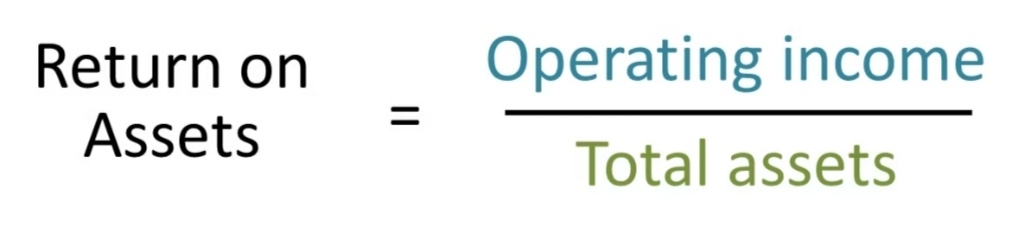
Let's say company ABC reported a total net profit of $2,500,000, with total assets at the end of year listed as $3,850,000.
To determine ROA, you would divide $2,500,000 by $3,750,000, which gives you 0.64935. Multiply by 100 and round up to get the percentage of 6.49%. This tells you that for every dollar in assets held by company ABC, they see 6.49¢ in profit.
Useful tips
1. The ROA will vary from industry to industry. To make comparisons you need to use an industry average return on assets for a comparable business operating in your sector.
2. The ROA will need to be higher than the return available if the same amount of money was invested in a minimal risk deposit with a bank.
3. ROA should always be higher than the rate at which the business borrows as an increase in borrowing leads to an increase in assets which in turn should give a higher return if the ROA is at the correct level.
ROA vs. ROE
Return on assets and return on equity are closely related financial ratios, and they complement each other when evaluating the performance of a single company.
ROE is calculated by dividing a company's net profits over a given period by the shareholders' equity. It measures how effectively the company is leveraging the capital it has generated by selling shares of stock. While ROA examines how well a company is managing its assets in terms of profits generated, ROE examines how well it is managing the money invested by shareholders in terms of profits generated.
Investors understandably want to know how well their equity is being used to generate profit, which is why ROE is a common metric used to measure company efficiency. ROA's measure of asset efficiency, then, complements the conclusions you can draw from ROE.
Limitations of ROA
Though ROA is a helpful calculation, it cannot be the only way investors and analysts measure a company's efficiency and financial health. That's because a company's ROA is influenced by a wide range of additional factors, from market conditions and demand to the fluctuating cost of assets a company needs to acquire. ROA, then, is a metric best taken in concert with other measures, like ROE and ROI, to gain a better picture of a company's overall status.
精彩评论