专题:全球财富管理论坛·2026上海苏河湾大会
10月20-22日上海黄浦江畔,2026可持续全球领导者大会再度来袭。诺奖、图灵奖得主现场讲述科技未来与趋势,更有“解救”焦虑、内卷时代的网红教授——麦克法兰与项飙现场对话! 名额有限,手慢无。让我们共赴可持续之约!【点击报名】
来源:全球财富管理论坛
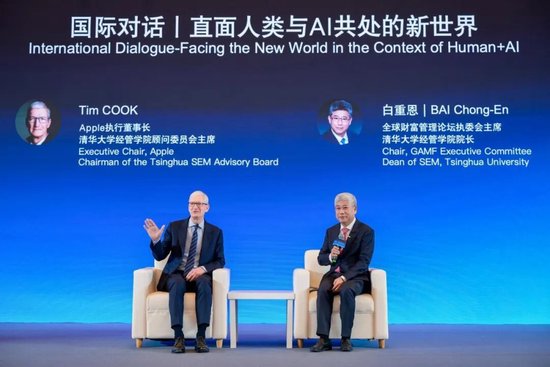
全球财富管理论坛•2026上海苏河湾大会于10月16日、17日在上海召开。Apple执行董事长、清华大学经管学院顾问委员会主席蒂姆·库克(Tim Cook)与全球财富管理论坛执委会主席、清华大学经管学院院长白重恩围绕“直面人类与AI共处的新世界”主题展开对话。这也是继2025上海苏河湾大会之后,Tim Cook第二次出席大会。Tim Cook与白重恩就人工智能带来的乐观与忧虑、AI如何服务人类、应用开发的民主化、供应链的智能化转型,以及科技企业更广泛的社会角色等话题深入交换了看法。
库克表示,他往来中国已近30年,此行感受最深的是中国当前的活力与动能,人们对未来的乐观情绪处于历史最高水平。他认为,技术应当服务于人类,而不是相反;AI在健康领域的应用正在加速,身体传感器在提供早期预警信号方面潜力巨大。他还谈到,AI正在推动应用开发的民主化,供应链的自动化水平已今非昔比,而这一切都要求人们为此做好准备。
白重恩则从教育一线出发,指出AI给教育带来了深刻挑战:职业阶梯上较低的台阶正在消失或萎缩,有动力与缺乏动力的学生之间的差距被进一步拉大。为此,清华经管学院提出了STAR框架,把找到正确的问题、技术素养、判断力和韧性作为四个关键的能力方向。他指出,在答案唾手可得的时代,提出正确的问题变得更加重要。
以下为本次对话的中文译文。
关于AI,人们对未来的乐观程度前所未有
白重恩:您来中国已经有几天了,去了广东和北京。到目前为止,这次访问给您留下了什么印象?最大的收获是什么?
蒂姆·库克:这是个好问题。从我1997年第一次来中国算起,至今已经将近三十年了。在这些年里,我爱上了中国人民和中国文化。每次来,我都能学到新的东西。
这次,我从广东开始了行程。Apple在中国的历程也是从那里开始的。这段历程始于一个制造难度很高的零部件。1998年,我们来到广东省寻求帮助,由此开启了大规模的制造业务,后来成为我们供应链的重要组成部分,生产iPhone、iPad和Mac。
这次让我感受到的是,中国现在充满活力。在我看来,人们对未来的乐观程度前所未有。大家积极拥抱AI的态度就体现了这一点。我说的不只是计算机科学家,而是所有人。
这种乐观精神给我留下了非常深刻的印象。我在应用开发者身上也看到了这一点。我们在北京设立了一家应用开发孵化器,过去这一周,孵化器举办了一场比赛,看看哪款应用最为出色,其中确实有一些非常好的作品。让我印象深刻的是,大家都在使用AI。孵化器中95%的应用都用到了AI。总之,我感受最深的,是大家对未来的乐观,以及相信“明天会比今天更好”的信念。
我到清华参访时,也在学生们身上看到了这一点:他们拥抱新的世界,积极运用这项具有变革意义的技术。在上海,我也能感受到这种氛围,无论是走访我们的零售店,还是昨天拜访那位通过“氛围编程”(vibe coding)开发应用的人。这种氛围无处不在。
白重恩:是的,人们对AI有不同的感受。就像您刚才说的,有些人比较乐观,也有人心存担忧。我很高兴您发现中国人对AI的态度更加乐观。
蒂姆·库克:是的,他们确实更加乐观。世界各地都有人担忧,这些担忧也有其道理。但我觉得,在中国,人们更愿意看到积极的一面。
科技应该为人类服务,而不是反过来
白重恩:很好。今天论坛的主题,是“直面人类与AI共处的新世界”。在您的职业生涯中,您一直强调为科技注入人文关怀的重要性。在全球经历变革的当下,您对AI的思考和做法如何体现这一理念?
蒂姆·库克:这一理念在我们的做法中体现得非常充分。我也很喜欢这次论坛的主题,因为我始终认为,科技应该为人类服务,而不是反过来。
科技应该始终着眼于改善人们的生活,让人们生活得更健康,帮助人们创作出原本无法创作的东西,让每一天过得更有效率。一切都应该服务于人类。我一直是这样看的。
AI给教育带来了非常深刻的挑战
蒂姆·库克:白院长,您现在在清华推动着一场重大变革,既涉及学生的学习,也涉及教师的教学。您怎么看待当下这个阶段?
白重恩:很多人都在积极拥抱AI,但我们也遇到了不少挑战。现在,课堂上一个对我们很重要的指标,就是学生的“抬头率”。很多学生埋头盯着电脑,不听老师讲课。这是我们目前面临的挑战。
我认为,AI给教育带来了非常深刻的挑战。一个问题是,职业阶梯最下面的几级正在消失或减少。因此,学生必须学会直接从更高的一级起步。这对我们来说是一个很大的挑战。
另外,我认为AI也在进一步拉大学习动力强的学生与学习动力不足的学生之间的差距。问题在于,学习动力不足的学生可以很快从AI那里找到答案,于是就不再学习了。这是一个很大的挑战。我们该如何激励学生利用AI更好地学习,而不是只是借助AI找到答案,跳过学习过程。这对我们来说是一个很大的挑战。
正因为有这些挑战,我们正在认真思考:教什么,以及怎么教。在顾问委员会会议上,我们提出了STAR框架,涵盖四个关键能力领域。
首先,S代表 Search,也就是明确需要回答的问题。在这个新的AI时代,这一点至关重要。
第二,T代表Tech-savvy,即技术素养,将传统技能、领导力等与技术结合起来加以运用。
第三,A代表Assessment,即评估,也就是作出判断的能力。
最后,R代表Resilience,也就是韧性。AI带来了很多不确定性,人们需要具备承受失败、直面失败的能力。因此,韧性、终身学习和领导力都非常重要。
这些思考影响着我们教什么、怎么教,以及研究什么、怎么研究。我们还面临很多问题,但我很高兴,顾问委员会委员们提出了很多非常宝贵的意见和建议。我们会认真研究这些建议,努力把工作做得更好。
我们正在进入一个问题比答案更重要的时代
蒂姆·库克:我认为,我们正在进入一个问题比答案更重要的时代。过去的教育模式是,老师提出问题,学生的任务是给出答案。现在,问题变得比答案更重要。因为在一个答案已知的世界里,你提出什么问题,就变得极其重要。我想,这在一定程度上需要我们调整思维方式。
现在比去年还要乐观
白重恩:您刚才提到,AI要为人类服务。那么具体怎么服务?从什么角度出发,采取什么方式,才能更好地为人类服务?这些都是非常重要的问题。我们希望学生在学习过程中,更快地学会思考这些问题。
您谈到如何让AI更好地为人们服务时,提到了让人们更加健康、提高效率等。在健康领域,您一直非常看好AI改善人类健康的潜力。去年您就谈过这个话题。一年过去了,您对这种潜力是否仍然感到同样振奋?在AI改善人们健康方面,您看到了哪些实实在在的进展?
蒂姆·库克:坦率地说,我现在比去年还要乐观。就健康领域而言,这一周非常令人振奋。本周,我们在中国推出了Apple Watch的睡眠呼吸暂停迹象提示功能。
睡眠呼吸暂停,就是人在夜间睡眠时会停止呼吸。这可能引发高血压、糖尿病等问题,造成严重后果。大多数有睡眠呼吸暂停的人并不知道自己有这种情况。现在,如果你有这种情况,手表就会向你发出提示,你就可以向医务人员求助,使用持续气道正压通气(CPAP)设备,或接受其他相应的治疗。这是一个例子。
另一个例子是,本周早些时候,我在北京见到一位有心律不齐情况的年轻人。他开始频繁在应用中收到提示,于是决定去寻求医疗帮助,最终被确诊为“心房颤动”,也就是“房颤”。“房颤”可能是一个“无声的杀手”。所以,在问题变得严重之前就提醒人们,意义非常重大。
我看到,不断有这样的新进展出现,越来越多这样的事情正在成为可能。我们目前正在与北京安贞医院开展研究,寻找更多心血管问题的早期指标。
总的来说,我认为,传感器在健康检测方面蕴含着巨大的潜力,它们可以及早发出预警,帮助人们生活得更健康。此外,还有一些很有帮助的提醒,让你了解自己睡得怎么样、运动了多少、站立了多久。这些提醒都很有用,因为我们都需要多活动,晚上睡得更好。第二天早上得到一个能指导你采取行动的评分,意义很大。
白重恩:是的。去年您谈到过利用AI在人们跌倒时发出警报。
蒂姆·库克:是的,没错。
白重恩:在人们跌倒之后,还能够立即通知医疗服务提供者。现在,您又把这项服务拓展到了睡眠呼吸暂停(蒂姆·库克答:没错),以及复杂的心脏健康问题。也就是说,您正在不断拓展服务,帮助人们应对健康风险。这非常好。
蒂姆·库克:想一想,现在的提示功能已经涵盖了多少方面:从睡眠、睡眠呼吸暂停,到心律不齐、房颤。你可以直接在手腕上做心电图检查,也可以查看血氧饱和度。早上,你会得到一个“准备指数”评分,了解自己的身体状态是否准备好迎接这一天。你还可以查看各项运动信息。这里面包含了大量数据,而这一切都是为了服务人类。
应用数量正在爆发式增长,应用开发在走向大众
白重恩:是的。Apple在中国拥有庞大的应用开发者群体,帮助人们更好地使用手机。有些人认为,随着AI的发展,应用正变得不那么重要。您如何看待应用的作用?又如何看待Apple与这些应用开发者之间的关系?
蒂姆·库克:坦率地说,我看到的恰恰相反。我看到应用数量正在爆发式增长。为什么会这样?因为AI正在帮助人们更快地编写代码。AI氛围编程也让那些过去连一行代码都没接触过的人能够编程。
昨天,我拜访了艺人胡彦斌。他正在通过氛围编程开发应用,与粉丝建立联系。在仅仅一年前,这还是做不到的。
所以,我确实看到应用正在大量涌现。可以说,应用开发正在走向大众。在我们运营的孵化器里、在我们举办的应用比赛中,都可以看到这一点。这种爆发式增长正在发生,而且在世界各地都是如此。
借助机器学习,(供应链)已经实现非常高的自动化程度
白重恩:是的。Apple在中国还有庞大的供应链。很多从业者在制造业工作,为Apple生产各种零部件、组装iPhone等产品。您认为AI会如何影响Apple的供应链?
蒂姆·库克:坦率地说,它已经产生了重大影响。很明显,机器人技术发展很快。还有质量检测等环节,过去相当依赖人工,现在借助机器学习,已经实现了非常高的自动化程度。
比如iPhone的颜色,当你生产数百万部手机时,需要确保每一部的颜色都保持一致。这些工作都以机器学习为基础。假如你十年前走进一家工厂,今天再走进同一家工厂,你会发现两者有天壤之别,自动化水平的差异非常大。
学生们正在以各种不同方式使用AI,也从中受益
蒂姆·库克:当然,这意味着你必须帮助员工做好准备。因此,我们有一个为供应商员工提供教育支持的项目,对此我们感到非常自豪。这个项目帮助员工提升能力,为AI驱动的未来做好准备。我们开设了AI课程、机器人技术课程,以及许多其他课程。你会看到,积极学习这些知识的人,晋升得很快。有些人入职时还是一线员工,很快就成长为主管和工厂管理者。这些都是教育带来的成果。
您也看到,学生们对AI的接受和运用程度各不相同。您在学生中看到了哪些有意思的应用案例?
白重恩:您刚才提到,艺术家胡彦斌通过氛围编程开发应用,与粉丝互动。我们的学生则是从另一个方向受益:很多人原本学生没有受过艺术训练,也不具备艺术创作和表达的技能。但现在,借助AI,这些学习科学、技术、工程、经济和管理的学生,也能够表达自己的创意了。过去,他们因为缺乏相关训练而做不到,现在可以了。所以,我们有很多学生正在尝试用这种方式更好地表达自己。这是一个很好的进展。
第二,很多学生都在做研究,尤其是博士生。对于一个刚开始接触某个新课题的学生来说,现在有了AI的帮助,熟悉这个领域变得容易多了,速度也更快。他们仍然需要判断已有研究的质量,但AI可以帮助他们更高效地收集和整理信息。
我们的学生还很有创造力,会开发AI智能体来帮助其他同学。比如,我们有很多国际学生,他们来到中国后,会遇到不少不太熟悉的问题。于是,学生会利用氛围编程开发了一个智能体,帮助新来的国际学生解答日常问题、应对生活中的困难。
所以,学生们正在以各种不同方式使用AI,也从中受益。但与此同时,我们希望他们继续探索,不断发现新的、需要解决的问题。
蒂姆·库克:是的,看到一个原本掌握某一类技能的人,借助AI突破自身的局限,学习和掌握其他技能,确实令人振奋。我认为,这是一个非常令人振奋的结果。
作为一家企业,我们的目标,是让世界因为我们的存在而变得更美好
白重恩:是的。我们一直在讨论人们如何借助AI提升自身能力。而Apple对中国民众的影响,已经超出了技术本身。多年来,我们多次谈到Apple对中国各类项目的支持。从这个角度出发,您如何看待Apple在社会中更广泛的作用?
蒂姆·库克:作为一家企业,我们的目标,是让世界因为我们的存在而变得更美好。这是我们要求自己的标准,我们也通过实际行动,从多个方面努力做到这一点。
举个例子,我们主张使用可再生能源来运营我们的设施。就在本周,我们宣布,在中国,我们95%的供应链已经采用可再生能源。我们的目标是到2030年达到100%,届时,我们希望公司实现碳中和。
我们也希望帮助弱势群体改善处境,获得更好的发展。因此,多年来,我们一直与中国发展研究基金会(CDRF)合作,关注乡村教育,促进乡村发展。这只是两个例子,说明我们如何努力做一些超越企业自身的事情,帮助人们获得更好的发展。
当然,我们也会开展一些与自身业务相关的项目,比如前面提到的应用比赛和应用开发孵化器,帮助创业者成长,让他们的应用从优秀走向卓越。这些都是我们十分关心的事,目的都是让世界因为我们的存在而变得更美好。
白重恩:是的,您提到了CDRF,也就是中国发展研究基金会。他们围绕如何更好地为乡村学龄前儿童提供营养和教育服务,开展了很多富有创新性的研究。这些工作产生了很大的影响,您的支持也非常重要。
蒂姆·库克:他们是一家非常出色的机构。他们的工作非常了不起,我们很自豪能够与他们合作。
白重恩:是的。您也在支持我们培养推动绿色转型的未来企业家。我们积极鼓励iPhone等产品供应链的绿色创新,也因此十分重视让学生有机会参与其中,开展创新实践。您的支持对我们开展这些工作至关重要。
蒂姆·库克:这对我们实现95%的供应链采用可再生能源,也起到了关键作用。很多学生参与了供应链中的相关工作。他们既积累了第一手的实践经验,也为世界带来了很大的积极改变。
白重恩:是的。我们正在组织供应链绿色创新比赛,也在培训企业高管,帮助他们更好地推进供应链和日常工作的绿色转型。我们的合作在这些方面确实发挥了重要作用。非常感谢您的支持。
蒂姆·库克:谢谢。
白重恩:也感谢您支持中国发展研究基金会的活动,以及中国的其他相关项目。我认为,这些工作对于教育发展和乡村发展都非常重要。
蒂姆·库克:我们很高兴能够参与其中,也从中学到了很多。
白重恩:好的。蒂姆,非常感谢您带来这场精彩的对话。
英文对话原文
Bai Chong‘en: Welcome back, Tim.
Tim Cook: It is great to be here, and I see some iPhones out there, so thank you very much.
Bai Chong‘en: This is the second consecutive year you are attending this conference. Thanks very much to your support for this organization.
Tim Cook: I am thrilled to be invited and back here with you, Dean Bai.
Bai Chong‘en: You have been in China for a few days. You visited Guangdong and Beijing. What‘s your impression of your trip so far? What are the biggest takeaways from this trip?
Tim Cook: It‘s a good question. You know, I’ve been traveling to China for almost 30 years. I came for the first time in 1997, and across that period of time, I fell in love with the Chinese people and the Chinese culture. Every time I come, I’ve learnt something. This time, I started my trip in Guangdong, that is where Apple‘s journey started in China. Apple’s journey started with a singular part that was so hard to produce. We went to Guangdong Province for help in 1998, and that would start a huge manufacturing business that would later become a significant part of our supply chain, producing iPhones, iPads, and Macs. But what I learned was how dynamic and vibrant China is right now. From my point of view, the level of optimism about the future is at an all-time high. You see this in the way people are leaning into AI—and I don’t mean just computer scientists; I mean everyone. So, I‘m very much struck by the optimism. I could see it in app developers. We launched an app incubator in Beijing that had a contest this past week to see which app was the best of the best, and there were some great ones in there. What struck me was that everyone’s using AI. 95% of the apps in the incubator were using AI. Again, the level of optimism and the belief that tomorrow is better than today was just paramount. I saw that at Tsinghua as well from visiting the school—the students there and how they‘re embracing the new world and leaning into this transformative technology. I can feel it in Shanghai as well, from our store visits and the Vibe Coder I visited yesterday. It’s everywhere.
Bai Chong‘en: Yes, people have different emotions toward AI. Some are more optimistic, as you suggested, while others have concerns. I‘m glad you find that in China, people are more optimistic.
Tim Cook: Yes. They are definitely more optimistic. There are concerns in the world. And rightfully so. There are some concerns out there, but I think people see it more glass half full in China.
Bai Chong‘en: Great, great. And the theme of today‘s forum is our world in the context of AI plus human. Throughout your career, you have always talked about the importance of infusing technology with humanity. At this moment of transformation around the world, how does your approach to AI reflect that philosophy?
Tim Cook: It reflects it very much, and I‘m so happy about the title of this forum. Because I’ve always felt that technology should serve humanity, not the other way around. Technology should be all about improving people‘s lives. Making people live a healthier day, maybe helping people create things they couldn’t create otherwise, helping people have a more productive day. Everything should be in the service of humanity. That‘s the way I’ve always seen it. Now, Dean Bai, you are presiding over a huge transformation right now at Tsinghua with students and learning, and teachers and teaching. How do you see this moment?
Bai Chong‘en: A lot of people are embracing AI, but we also encounter a lot of challenges. In the classroom, one indicator that‘s very important to us is now how many of the students are raising their heads in the classroom. Many of them bury their attention in their computers; they don’t listen to the instructor. So that‘s our challenge now. I think AI brings a very profound challenge to education. One is that on the career ladder, the lower rungs are vanishing or diminishing. So, you have to learn to be able to climb from the upper rung immediately. That’s a grand challenge to us. Also, I think AI makes the difference between motivated students and less motivated students even wider. The problem is that with less motivated students, they can quickly find answers from AI. So, they stop learning. That‘s a great challenge. How do we motivate students to utilize AI to better learn instead of utilizing AI just to find a solution without the learning process. So, that’s a great challenge to us. Because of these challenges, we‘re thinking really hard about what to teach and how to teach. In our board meeting, we presented our STAR framework—4 key areas of skills. First, S stands for Search: identifying the questions to answer. That’s crucial in this new AI era. Second, T is for Tech-savvy: using traditional skills, leadership skills, etc., together with tech. Third, A is for Assessment—the ability to make judgment. Finally, R is for Resilience. With AI bringing so much uncertainty, people have to have the ability to take failure, and to face failure. So, resilience, lifetime learning, and leadership are all very important. This shapes our thinking on what and how to teach, and what and how to research. There are many issues that facing us, but I‘m glad our board members gave us a lot of very valuable advices and suggestions. We’ll look at their suggestions and try to improve our work even better.
Tim Cook: I think we‘re moving into an environment where the questions are more important than the answer. You know, education used to be: the instructor asks a question and the student’s responsibility was to give an answer. Now the question becomes more important than the answer. Because in a world where the answers are known, the questions that you ask become extremely important. And I think it‘s a rewiring of the brain a bit.
Bai Chong‘en: You mentioned how to serve humanity. How to serve? There are a lot of questions. From which angle, what approach to take to better serve humanity? So those are very important issues. We want our students to learn that quicker in their studies. And when you talked about how to make AI serving people better, you talked about making people healthier, you talk about making people more productive, etc. In the health sector, and you had a lot of optimism about how AI may impact human health. Now, last year you already talked about this. One year later, are you still as excited about this potential? And what tangible progress have you seen when it comes to AI improving people‘s health?
Tim Cook: I am more optimistic today than I was even last year, to be frank with you. This week has been a great week from a health point of view. We were able to launch our sleep apnea notification on the Apple Watch this week in China. As you know, sleep apnea is where the person stops breathing during the night, and this can create problems like hypertension, diabetes, and terrible outcomes. Most people that have sleep apnea don‘t know it. Now, the watch will notify you if you have it, so you can seek help from a medical professional to get on a CPAP machine or whatever the treatment may be. That’s one example. Another example: I was in Beijing earlier this week and visited a young man who was having an irregular heartbeat. He began to get notifications very frequently on the app, which convinced him to reach out for medical help, and he was diagnosed with AFib. As you know, AFib can be a silent killer, so it‘s huge to notify people that they have these kinds of issues before they become very problematic. I see more and more of these things coming out and more and more these things being possible. We’re now doing research with Beijing Anzhen Hospital, searching for even more early indicators on the cardiovascular side. But the bottom line is, I see enormous potential in body sensors giving early warning signs so you can live a healthier life. I also see these helpful reminders about how you‘re sleeping, how much exercise you’re getting, and how much you‘re standing. All of these are very nice reminders that we all need to be more active and get a better night’s rest. And getting a score the next morning that is actionable is big. You know, we can all learn from those.
Bai Chong‘en: Right, last year you talked about the application of AI to alert people of falling.
Tim Cook: Yeah, that‘s right.
Bai Chong‘en: And after they fall, they can immediately notify health service providers. So, now you‘re extending the service to deal with apnea.
Tim Cook: That‘s right.
Bai Chong‘en: And to deal with difficult heart conditions. So, you‘re extending your service to help people deal with health risks. That’s great.
Tim Cook: Think about all the ways notifications work now—from sleep-to-sleep apnea, to irregular heartbeat, to AFib. You can run an ECG on your wrist. You get a readiness score in the morning to denote your readiness for the day. You have all your exercise info. This is just your SpO2. It‘s an enormous amount of data, all in the service of humanity.
Bai Chong‘en: Right, right. Apple has a large community of app developers in China helping people to use the phones better. And some people suggest that with AI, apps are becoming less important. How do you see that? How do you view the usefulness of apps? And how do you think about your relationship with all these app builders?
Tim Cook: I see the opposite happening, honestly. I see apps exploding. And why is that happening? It‘s because AI is helping people code faster. AI vibe coding is helping people code who never touched a line of code before. I visited an entertainer yesterday, Tiger Hu. And Tiger is vibe coding apps to connect with his fans. Well, this could not have happened even 1 year before. And so, I actually see an explosion of apps taking place, and sort of the democratization of app development is taking place right now. And you can see it in the incubator that we ran. You can see it in the app contest that we run. It’s just exploding, and it‘s exploding around the world as well.
Bai Chong‘en: Right. And you have a large supply chain in China. Many of the people are in the manufacturing sector helping make different components for Apple and assemble the Apple phone, etc. How do you think AI will affect your supply chain?
Tim Cook: It has affected it in significant ways already, to be honest. Obviously, robotics has really taken off. But you also have things like the art of inspection that used to be quite manual—now machine learning has made that very, very automated. If you look at something like the color of an iPhone and making sure it‘s the same from iPhone to iPhone as you produce millions of these, all of that is machine learning oriented. If you walked into a factory 10 years ago and then walked into that same factory today, it would be night and day. The differences in the level of automation are huge, and of course that means you have to prepare people for this. So, we have a program that funds supplier education that we’re very proud of, one that begins to lift up people and get them ready for an AI-forward world. We have AI courses, robotics courses, many other things, and you can see people rising through the ranks rapidly that embrace this. You know, you see people that hired in as entry-level workers all of a sudden become supervisors and managers of the facilities. And all of this is an output of the education. Now you‘ve seen students adopt at different levels. What kind of interesting use cases are you seeing with students?
Bai Chong‘en: Okay, you mentioned the case of this artist, Tiger Hu, using vibe coding to connect with his fans. Our students are doing the reverse. Many of them didn‘t have any training in art or skills in creative expression. But now with the help of AI, these science, technology, engineering, economics, and management students can express their creative ideas. They couldn’t do this before because they lacked the training, but now they can. So many of our students are experimenting with this to better express themselves. That‘s a great development. Secondly, for a student to get started—many of our students are doing research, especially our PhD students—to become familiar with a new topic, it’s now much easier with the help of AI. They can do it quicker. They still need to make judgments about the quality of existing research, but AI helps them gather and organize information in a much more efficient way. And our students are also creative in creating agents to help other students. For example, we have many international students. When they come to China, they deal with many issues that are less familiar to them. And so, our student union, using vibe coding, set up this agent that helps incoming international students answer the day-to-day questions and challenges they face. So, our students are using AI in many different ways, and they are benefiting from it. But at the same time, we want them to keep doing it, to keep finding new questions to solve.
Tim Cook: Yes, it‘s very exciting to see how someone with 1 skill set is transcending themselves and growing with other skill sets with AI. I think this is an exciting outcome.
Bai Chong‘en: Right, right. And we have been discussing how AI can empower people. And Apple‘s impact on people in China extends beyond technology itself. Over the years, we have spoken many times about Apple’s support for a wider range of initiatives in China. With that in mind, what‘s your view of Apple’s broader role in the society?
Tim Cook: Yeah, our goal in life as a company is to leave the world better than we found it. That‘s the bar we hold ourselves to, and we try to do that in a number of ways by how we show up. So, one example would be, we believe in running our facilities on renewable energy. Just this week, we announced that 95% of our supply chain is run on renewable energy in China. Our goal there is to reach 100% by 2030, at which time we want the company to be carbon neutral. We also believe in raising up and lifting underprivileged people. So, we’ve been working with CDRF for many years, focusing on rural education and lifting rural societies. These are just 2 examples of where we‘re trying to do something beyond ourselves to raise people up. Of course, we also do things that intersect with our business, like the app contest and the app incubator I talked about earlier, to lift entrepreneurs and raise the bar of their apps from good to great. These are all things we care deeply about, and they’re all meant to leave the world better than we found it.
Bai Chong‘en: Yes, you mentioned CDRF, China Development Research Foundation. They‘ve been doing very creative research on how to better provide nutrition and education services to rural kids before school age. That work has been very impactful, and your support has been very important.
Tim Cook: They are an incredible organization. They do unbelievable work, and we are so proud to partner with them.
Bai Chong‘en: Right. You are also supporting us in educating future entrepreneurs for green transformation. We are very enthusiastic about encouraging innovation in the iPhone supply chain and other products. So, it‘s important to give students opportunities to practice innovation in this area. Your support has been instrumental for us to be able to do this.
Tim Cook: And it‘s been key for us to achieve the 95% renewable energy. You know, we’ve had a lot of students in the supply chain helping out with that. And so, they‘re gaining firsthand experience and making a huge difference for the world.
Bai Chong‘en: Right, so we are organizing competitions on green innovation in the supply chain. We are training executives so that they can better green their supply chain and green their work. So, thanks, our partnership really makes a difference there. Thank you very much for your support.
Tim Cook: Thank you.
Bai Chong‘en: And also, thanks to you for your support to the activities of China Development Research Foundation and other Chinese initiatives. I think they are very important for the development of education and for the development of rural areas.
Tim Cook: We love being associated with it. And we‘ve learned so much from doing it.
Bai Chong‘en: Okay, thank you very much, Tim, for the great conversation.
Tim Cook: Thank you!
精彩评论